39.69° N · 3.02° E — THE YACHT MEDIC
1. Medical Training for the Moment Help is A Long Way Away
Approved - STCW Medical qualifications and Psychological First Aid at Sea
Taught by a Health Educator, Emergency Nurse & Professional Sailor with 30 years on the water, not just in the classroom.
MCA Approved - STCW Compliant in Palma de Mallorca, and Onboard Worldwide
MCA Approved - STCW Compliant
Onboard Training Globally
Classroom Training Palma de Mallorca
The recognised maritime medical qualifications - for anyone designated to give first aid or take charge of medical care onboard.
Medical First Aid (3 Days )
Proficiency in Medical Care (4.5 Days)
Update in Medical Care (3 Days)
Psychological First Aid (0.5-2 Days)
Bespoke Training
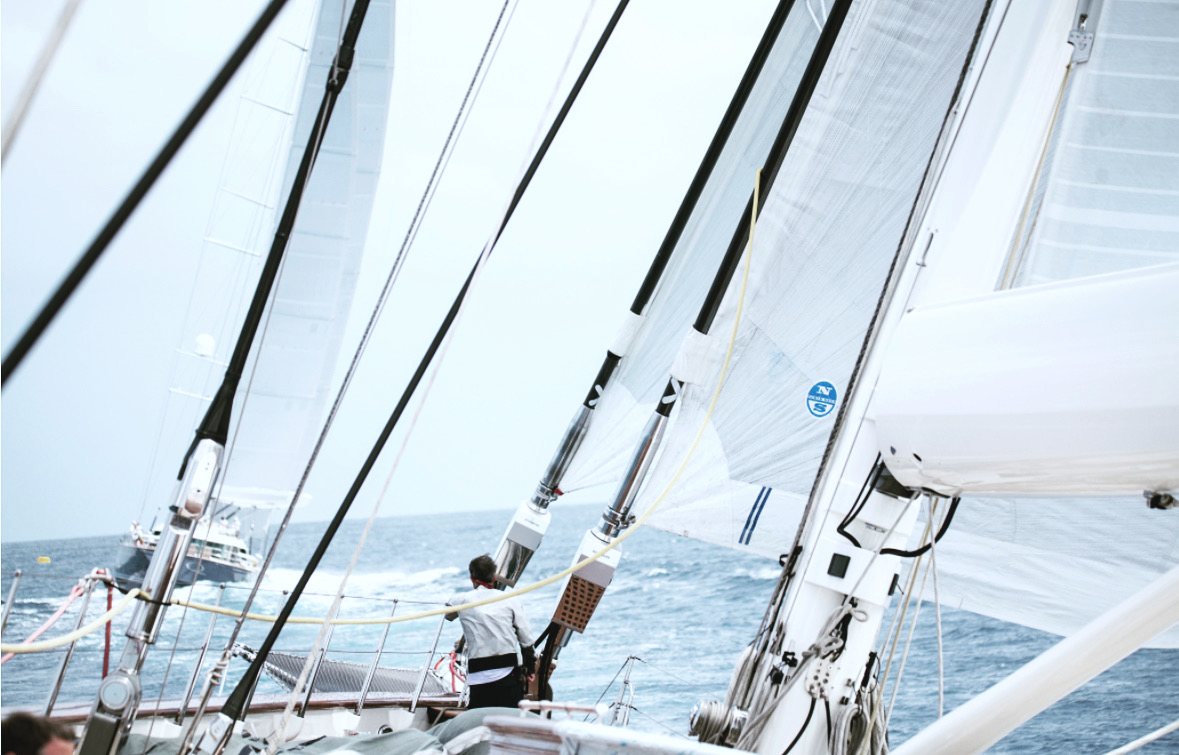
Psychological First Aid at Sea
Every crew knows what to do about a wound, almost none know what to do about the fear.
The missing part of the medical kit.
The WHO Look, Listen & Link model adapted for maritime.
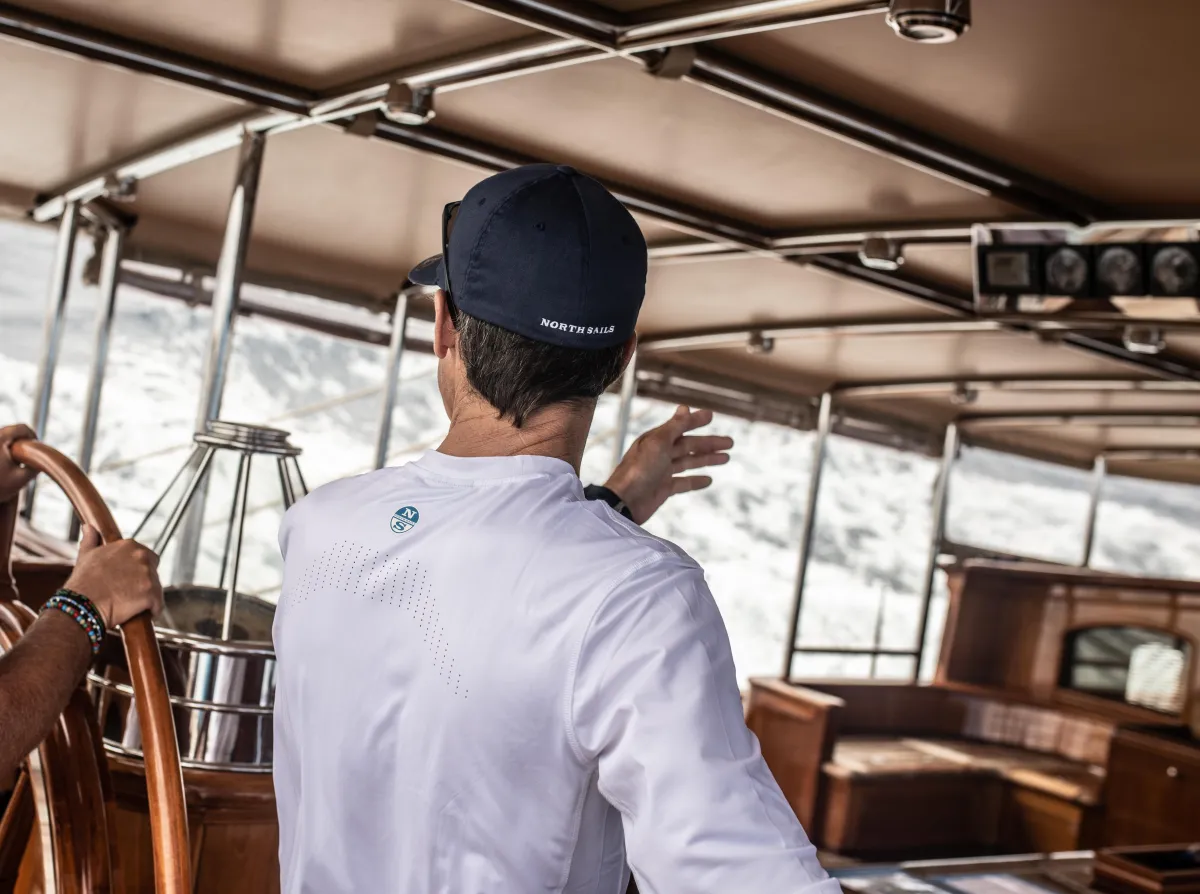
Resilience at Sea
Resilience at Sea — a 27-page handbook for superyacht crew on the people problems nobody trains you for: an owner losing their temper, a crewmate falling apart, and the aftermath everyone pretends didn't happen.
With practical scripts, clear escalation thresholds, and a tear-out quick reference. Not therapy, not clinical training. The words to use when help is hours away.
.
About Amanda
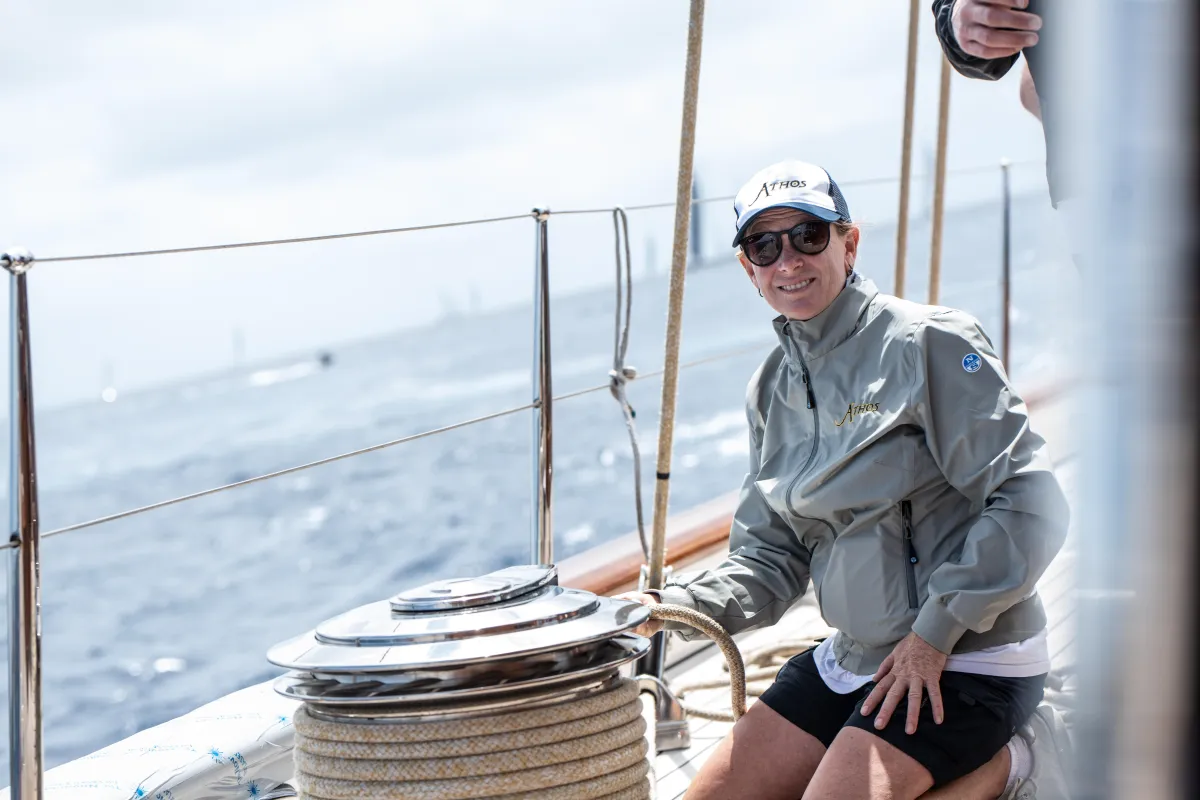
The Yacht Medic is Amanda Hewson Beaver — a registered nurse, former paramedic, and rescue and retrieval nurse who has been the nearest person more times than she can count. In the outback, in refugee camps, offshore, and on the deck of a boat a long way from help.
She has been the medic on the Sydney Hobart, the Fastnet, and the Rolex 600, and has trained Olympic, Ocean Race, America's Cup, and J Class teams. She teaches what she has actually done — which is why crew remember it.
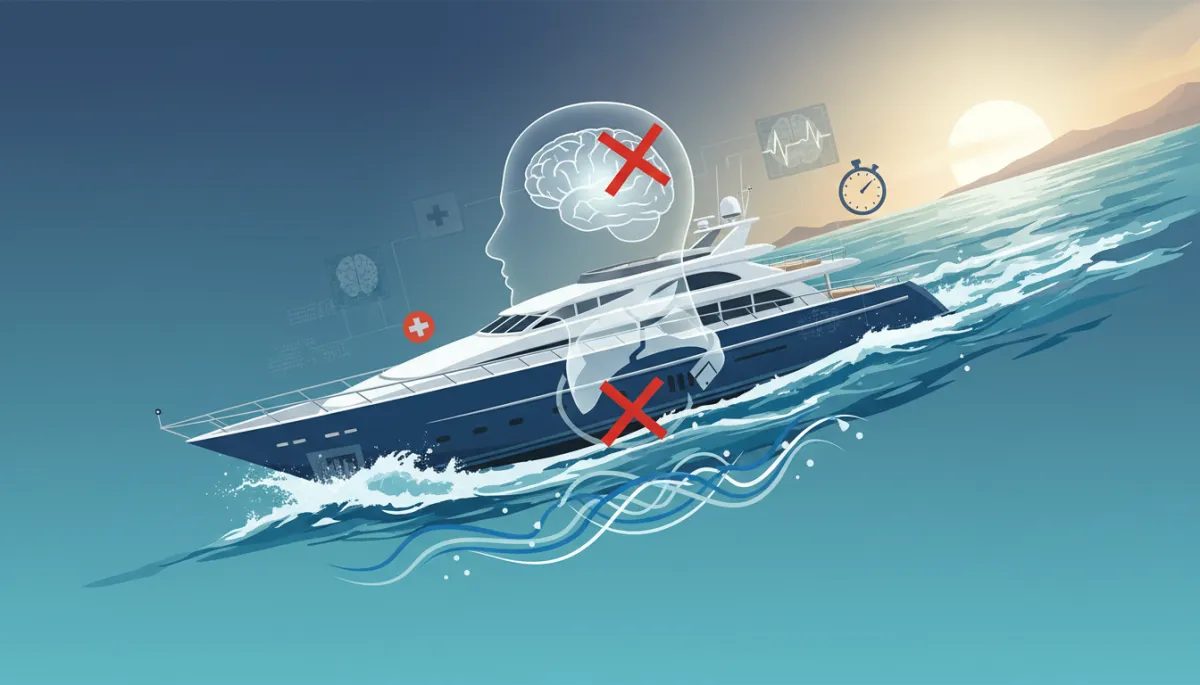
Head Injuries at Sea: Modern Spinal Care
Maritime Medicine, Head Injuries, Spinal Motion Restriction, Superyacht Racing
Head Injuries at Sea & Why We’ve Stopped Reaching for Head Collars in Suspected Spinal Injuries
St Barths Superyacht Racing Medical Series – Part 3 explores what really matters after a head injury on deck: rapid recognition, calm crew response, and modern spinal motion restriction instead of outdated, routine collar use.
The Reality of Head Injuries at Sea
Superyacht racing around St Barths is spectacular – high loads, high speeds, and split‑second decisions on a moving, unforgiving platform. It is also the perfect storm for head injuries. A swinging boom, a sudden broach, a crew member slipping on a wet foredeck, or a grinder knocked sideways in a crowded cockpit can all deliver enough force to cause a traumatic brain injury (TBI) and potential spinal damage in the same instant.
At sea, you do not have the luxury of a nearby trauma centre. Weather, distance, and communications all conspire to delay definitive care. That makes the first 10–20 minutes after a head injury on deck absolutely critical. What the crew does – and just as importantly, what they don’t do – can influence the casualty’s outcome long before a helicopter or chase boat arrives.
Why Head Trauma on a Superyacht Is So Dangerous
Head trauma is not always dramatic. A deep scalp laceration bleeds impressively but may hide a relatively minor underlying injury. Conversely, a seemingly “light tap” can cause a serious brain injury with no external mark at all. Current trauma guidelines from organisations such as the CDC and the American College of Surgeons emphasise that any significant blow to the head should be treated with caution until properly assessed (CDC, 2025; ACS TQP).
Limited space and hard surfaces: Carbon booms, metal winches, and deck hardware concentrate force into small areas, increasing the risk of skull fracture and brain injury.
Secondary impacts: A sailor may be thrown, strike the deck, then a stanchion, then a winch. Each impact adds risk for both head and spinal trauma.
Delayed evacuation: Even with excellent race medical cover, you may be 30–60 minutes or more from a hospital scan. Early crew decisions must assume “worst case” until proven otherwise.
The dangers are not limited to obvious severe trauma. Mild traumatic brain injury – concussion – is far more common, and poorly managed concussion can lead to prolonged symptoms, impaired performance, and increased vulnerability to further injury. The latest CDC mild TBI guideline for adults (2025) and its HEADS UP programme stress careful symptom monitoring and a stepwise return to activity, not a rushed “back on the grinder” approach (CDC HEADS UP, 2025).
Concussion Symptoms: What Crew Must Recognise Immediately
In the noise and adrenaline of a race, it is easy to miss early concussion signs. Yet recognising them is one of the most important safety skills a racing crew can develop. A concussion is a mild traumatic brain injury caused by a blow to the head or a jolt that shakes the brain inside the skull. You do not need a loss of consciousness for it to be serious.
Immediate concussion symptoms
Headache or “pressure” in the head
Dizziness, unsteadiness, or feeling off‑balance on deck
Confusion, appearing dazed, slow to respond, or “not themselves”
Nausea or vomiting after the impact
Sensitivity to bright sunlight or winch noise
Delayed concussion symptoms (minutes to hours later)
Difficulty concentrating on tasks or race calls
Memory problems – not recalling the incident or previous leg of the race
Irritability, unusual emotional responses, or personality change
Sleep disturbance after the race – either insomnia or excessive sleepiness
📌 Key Takeaway: Any crew member with suspected concussion is out of the race. No “just one more leg”, no “I’ll be fine”. Modern concussion guidance is clear: remove from activity and seek medical assessment before any return to racing (CDC HEADS UP).
Proper Assessment & Response: What Good Looks Like on Deck
In a busy cockpit, the temptation is to drag the casualty clear, sit them up, slap on a collar, and get back to trimming. Modern trauma care – and best practice for head injuries at sea – tells us to slow down, protect the spine, and focus on the basics: Airway, Breathing, Circulation, Disability (neurology), and Exposure, all while minimising spinal movement.
Stepwise assessment for head injuries at sea
Scene safety: Secure the boom, ease sheets, and stabilise the boat as much as possible. You cannot treat safely while the casualty is still at risk of another impact or going overboard.
Initial impression: Is the casualty responsive? Breathing normally? Bleeding heavily? Use simple prompts: “Can you hear me? Tell me your name. Where are you?”
Manual spinal motion restriction: As soon as you suspect significant head impact, one crew member should take manual control of the head in a neutral position – hands either side of the head, elbows braced. This is your first and most important “spinal protection device”.
Airway & breathing: Look, listen, and feel for breathing. If they are unconscious but breathing, maintain airway while keeping the head and neck aligned with the torso as best you can. If not breathing, follow your CPR training and local race protocols – life‑saving interventions always trump perfect spinal immobilisation.
Control bleeding: Scalp wounds can bleed dramatically. Apply firm direct pressure with dressings while another crew member maintains head support. Do not probe the wound or attempt to clean deeply; your priority is bleeding control and spinal motion restriction, not cosmetic repair at sea (Sea health guidance).
Neurological check: Use simple tools – AVPU (Alert, responds to Voice, responds to Pain, Unresponsive) or basic questions about time, place, and event. Note any confusion, unequal pupils, weakness, or seizures. These findings need to be relayed to medical support and can change rapidly over time.
💡 Pro Tip: Nominate one crew member as “scribe”. They note times, symptoms, responses, and communications with race or tele‑medical support. This simple step dramatically improves handover quality once professional help arrives.
Why We No Longer Reach Automatically for Head Collars
For years, the reflex in prehospital trauma care – on land and at sea – was simple: suspect spinal injury, apply a rigid head or cervical collar. It felt logical and looked reassuring. Yet over the past decade, large international bodies including ILCOR, ERC, AHA, and ANZCOR have moved away from routine collar use in suspected spinal injuries, emphasising spinal motion restriction instead (ANZCOR, 2026; Global Wind Organisation, 2026).
The problems with rigid head and cervical collars
They don’t fully stop movement. Studies show collars provide limited restriction and can even cause paradoxical motion if poorly fitted or if the torso moves more than the head. On a moving yacht, that mismatch can be significant.
They can increase intracranial pressure (ICP). Tight collars may impede venous return from the brain, potentially worsening outcomes in patients with head injuries and swelling – precisely the group we are trying to protect (GWO standard, 2026).
They can compromise the airway. In vomiting or drowsy casualties, collars can make airway management harder, reduce jaw movement, and delay life‑saving interventions. At sea, where evacuation is delayed, airway access is non‑negotiable.
They cause pain and pressure injuries. Prolonged collar use is associated with skin breakdown and discomfort. On a long passage back to harbour, this is a real concern.
Critically, despite decades of widespread use, there is no high‑quality evidence that routine collar application improves neurological outcome or prevents delayed paralysis (NAEMSP, 2026). That is a sobering fact – and it is why modern trauma care has changed course.
Spinal Motion Restriction: What We Do Instead
The focus has shifted from “immobilise the neck at all costs” to “minimise unnecessary movement of the entire spine while prioritising life‑saving care.” This is spinal motion restriction (SMR), and it fits the dynamic environment of superyacht racing far better than rigid collars and head blocks.
Manual in‑line stabilisation first. Hands on the head and neck, keeping them aligned with the torso, remains the gold standard initial intervention. It is simple, effective, and instantly available on any yacht (ANZCOR, 2026).
Neutral positioning with padding. If the casualty is on deck, use folded towels, sail bags, or foam to support the head and torso in a neutral, aligned position once manual support can safely be shared or relieved. Avoid forcing the neck into an uncomfortable position.
Minimise transfers and log‑rolls. Every unnecessary move risks spinal motion. If the casualty is safe where they are and protected from further harm, keep them there until professional rescuers direct otherwise. If you must move them, plan the move, brief the team, and move as one unit.
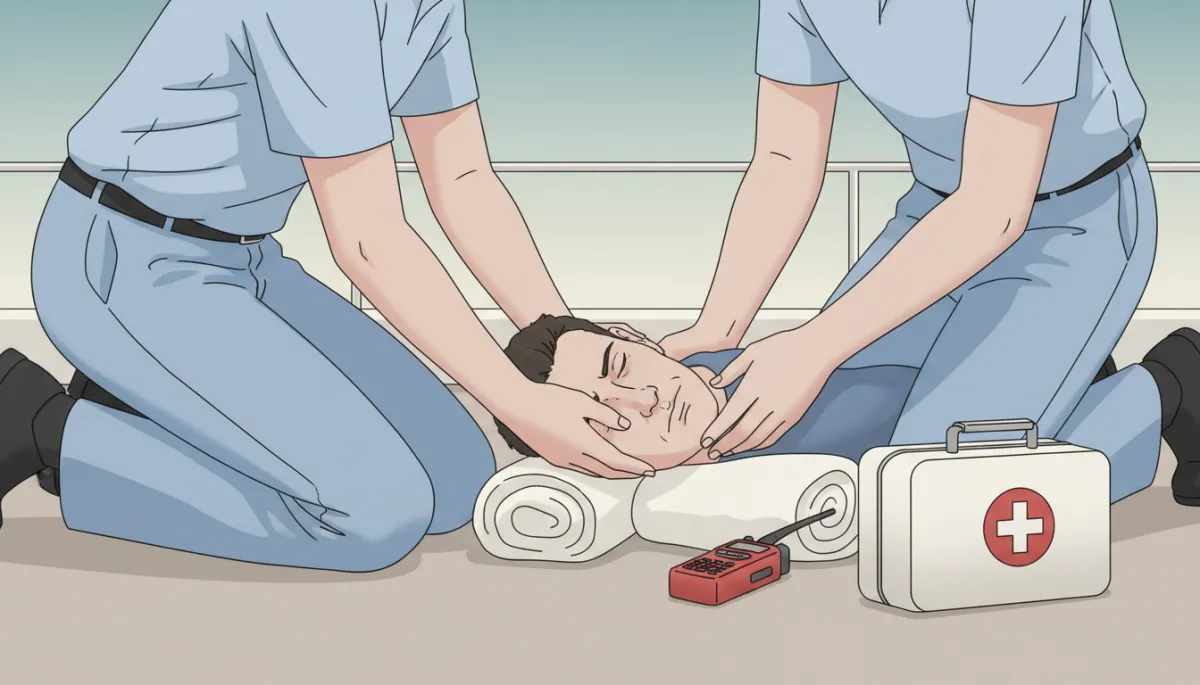
Simple manual support and padding often protect the spine better than a poorly fitted collar at sea.
International first‑aid‑level guidance even warns against rigid head blocks that restrain the head more than the torso, as they can increase cervical motion during vessel movement (ANZCOR, 2026). On a superyacht, where the deck is constantly pitching and rolling, this warning is particularly relevant.
Critical Steps for Crew After a Head Injury on Deck
Whether you are a professional race crew or a guest sailor, your actions in the minutes after a head injury can make a profound difference. The following sequence provides a practical framework tailored to superyacht racing conditions around St Barths and beyond.
Stop the immediate danger. Control the boom, ease the sheet, clear lines, and stabilise the yacht’s course. Prevent further impacts or a man‑overboard situation before you focus on treatment.
Assign roles. One person takes the head and maintains manual spinal motion restriction. Another manages airway and bleeding. A third handles communications and timing. A fourth, if available, controls the environment (shade, wind, equipment).
Perform a quick primary survey (ABCD). Check airway, breathing, circulation, and disability (level of consciousness). Life‑threats – such as airway obstruction or massive bleeding – override concerns about perfect spinal alignment, but always resume SMR as soon as possible afterwards.
Control scalp bleeding and protect the wound. Use sterile dressings or clean cloth. Apply firm, steady pressure. If there is suspicion of a skull fracture (soft, spongy area; visible depression; clear fluid from ears or nose), avoid pressing directly into the defect – pad gently around it instead, and communicate this to medical support (Maritime head injury guidance).
Call for help early. Inform race control, the support fleet, and tele‑medical services as soon as you have basic information: mechanism of injury, level of consciousness, major bleeding, and your current location. Early calls allow planning for helicopter or fast‑boat evacuation if needed, which is crucial in the Caribbean island environment.
Monitor for concussion and deterioration. Repeat simple questions at intervals. Watch for worsening headache, repeated vomiting, increasing confusion, seizure activity, or one pupil becoming larger than the other. Any deterioration is an emergency signal for rapid evacuation, in line with modern TBI guidelines (CDC/ACEP, 2025).
Avoid alcohol, sedatives, and unnecessary medication. These can mask symptoms and complicate assessment. Pain relief, if used, should follow your medical kit protocols and tele‑medical advice, with careful documentation.
📌 Key Takeaway: Your job is not to make a hospital‑level diagnosis; it is to protect the brain and spine, prevent further harm, and provide clear information to professional responders.
Scenario: Boom Strike During a St Barths Superyacht Race
Imagine a 40‑metre racing superyacht powering upwind off St Barths. The breeze is up, the sea state is building, and crew are cycling through tacks on a tight layline. During a fast tack, the main sheet snatches, the boom loads up, and as it whips across, a trimmer loses footing on the wet deck. The boom glances off his helmet, snapping his head sideways, and he collapses against the cockpit coaming before sliding to the sole.
Old reflex vs. modern best practice
Ten years ago, many crews would have sat him up, slapped on a rigid head or cervical collar from the race medical kit, and tried to shuffle him to a more convenient spot. Today, with updated guidance, the response looks very different:
The helm steadies the yacht and calls “Man down, head injury, standby!”
A designated first‑aid crew member drops to the casualty, places hands gently but firmly either side of the head, and keeps it aligned with the torso. No attempt is made to twist or flex the neck into a “perfect” position.
Another crew member checks responsiveness: he is confused, answers slowly, and does not recall the tack. There is a scalp laceration with moderate bleeding but no obvious skull depression. Breathing is normal, and pulses are present.
Dressings are applied with direct pressure. Towels are placed either side of his head and shoulders to maintain neutral alignment once more hands are needed elsewhere. No rigid collar is applied, because manual and padded SMR are already effective and safer in the moving cockpit.
Race control is informed: suspected concussion, possible spinal injury, currently stable ABCs, location transmitted. Tele‑medical advice confirms the plan: maintain SMR, monitor for deterioration, prepare for transfer to a support vessel when conditions allow. The casualty is kept lying, shaded, and reassured. He is not allowed to sit up or “walk it off”, and he is certainly not returning to the winch.
Training, Drills & Culture: Making This the New Normal
The St Barths Superyacht Racing Medical Series is about more than checklists. It is about changing culture on board – from “tough it out” to “protect the brain and spine first”. To embed modern practice, yachts should:
Run regular head injury and SMR drills during training days, including realistic scenarios in foul weather gear and harnesses.
Brief all crew – professional and guest – on concussion red flags and the “no same‑day return to racing” rule after suspected concussion, in line with current sports and CDC guidance (CDC HEADS UP, 2025).
Review the medical kit to ensure it supports SMR: adequate dressings, padding materials, and clear written protocols. If collars are carried, they should be used sparingly and only under guidance, not as an automatic response.
💡 Pro Tip: Include medical scenarios in pre‑race briefings just as seriously as sail‑handling and man‑overboard drills. When the boom hits, muscle memory matters.
Final Thoughts: Protect the Brain, Respect the Spine, Rethink the Collar
Head injuries at sea are inevitable in a sport that pushes yachts, gear, and people to their limits. Poor outcomes, however, are not inevitable. By understanding the dangers of head trauma, recognising concussion early, and responding with calm, structured assessment, superyacht crews can dramatically improve the odds for injured sailors.
The era of automatically reaching for a rigid head or cervical collar is over. Modern trauma care – from ANZCOR first‑aid guidance to advanced rescue standards – prioritises spinal motion restriction, manual support, and neutral positioning over routine collar use. At sea, where movement, airway access, and evacuation delays are everyday realities, this shift is not just academic; it is profoundly practical.
As you prepare for the next St Barths Superyacht Regatta, make sure your crew’s reflex is the right one: hands on the head, eyes on the airway, mind on concussion, and a healthy scepticism about collars. That is how modern racing teams protect both performance and people when it matters most.